March 12, 2026
ASCET Releases First-of-Its-Kind Scan on AI Standardization
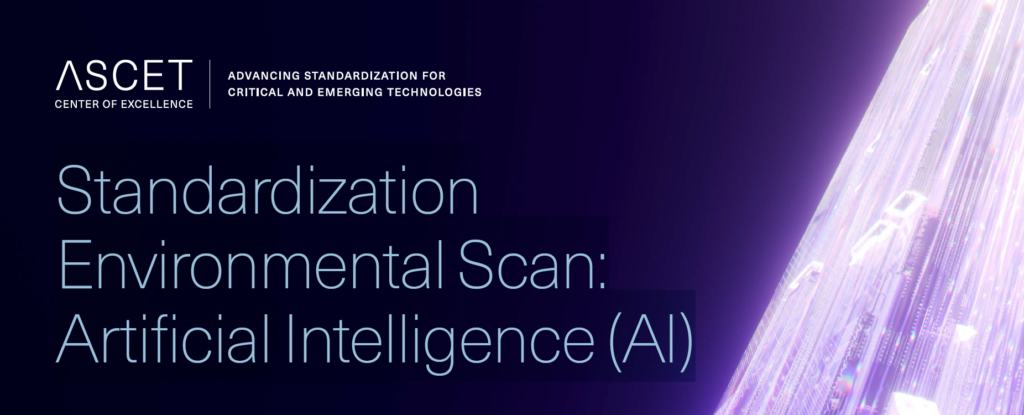
W. CONSHOHOCKEN, Pa., March 12, 2026 – The ASCET Center of Excellence has published a new environmental scan report that maps the current landscape of artificial intelligence (AI) standardization to determine priorities for advancing U.S. leadership in AI.
The assessment synthesizes publicly available standards databases, government and industry strategic documents, and input from government, industry, and academia to identify areas of maturity, emerging needs, and priorities for pre-standardization research.
The scan assesses AI standardization at all levels by:
- Identifying key AI stakeholders and their current roles in the industry
- Mapping existing AI standards and standardization activity, including current roadmaps and strategy documents
- Assessing emerging gaps in the field, from general challenges posed by the technology to areas currently lacking standards
- Providing an in-depth summary of ongoing AI standardization efforts, including work by standards development organizations and federal agencies, draft standards, strategies, consortia, and active standards initiatives
“AI is advancing faster than the standards infrastructure needed to support its safe and responsible deployment,” says Mohsen Seifi, Ph.D., ASTM International vice president and principal investigator for ASCET. “This scan gives stakeholders across government, industry, and academia a clear picture of where standards exist, where the gaps are, and where we need to focus our collective efforts to ensure the U.S. remains at the forefront.”
The report recommends actionable steps for advancing AI standardization, including an agile approach to keep pace with the technology’s rapid progression, more robust training for risk evaluation and mitigation, development of factuality and trustworthiness benchmarks, and more.
The findings of the AI scan will inform ASCET’s upcoming activities on the topic, such as workshops, roadmap development, and prioritization of standardization efforts. Future engagement on this and other CETs will further ASCET’s goal of supporting U.S. standards alignment to promote national competitiveness, economic security, and innovation.
The newly published scan is the first in a series of four scans, covering each of ASCET’s four critical and emerging technologies: AI, biotechnology, quantum technology, and semiconductors and microelectronics. These reports will be published and updated periodically in the coming months.
The AI standardization report is available at www.ascet.com, where stakeholders can also explore opportunities to engage with ASCET’s upcoming initiatives.
Support for this activity is provided, in part, by National Institute of Standards and Technology financial assistance award 70NANB24H334.
About ASCET
ASCET – Advancing Standardization for Critical and Emerging Technologies – is a transformative initiative aimed at supporting private sector-driven U.S. engagement and capacity building in the development and use of international standards. Learn more at www.ascet.com.
About ASTM International
Advancing standards and transforming markets, we touch every part of everyday life – helping our world work better. Over 12,000 ASTM standards operate globally. Defined and set by us, they improve the lives of millions every day. Combined with our innovative business services, they enhance performance and help everyone have confidence in the things they buy and use.
Media Inquiries: Gavin O’Reilly, tel +1.610.832.9618; goreilly@astm.org
ASCET Contact: Sarah Bloomquist, tel +1.845.309.3398; sbloomquist@astm.org
About ASTM International
Advancing standards and transforming markets, we touch every part of everyday life – helping our world work better.
Over 12,000 ASTM standards operate globally. Defined and set by us, they improve the lives of millions every day. Combined with our innovative business services, they enhance performance and help everyone have confidence in the things they buy and use.