June 9, 2026
ASCET Charts Biotechnology Landscape, Identifies Emerging Gaps to Drive U.S. Engagement
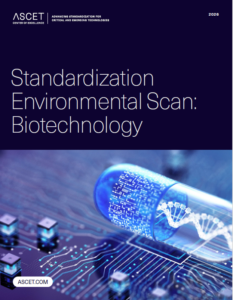
W. CONSHOHOCKEN, Pa., June 09, 2026 —The ASCET Center of Excellence has released an environmental scan that maps the current biotechnology standardization landscape — including bioprocessing, biosafety, agricultural biotech, and biofuels — and identifies the pre-standardization gaps most consequential to sustained U.S. leadership in the field.
The scan assesses biotech standardization at all levels by:
- Identifying key biotech stakeholders and their current roles, including industry leaders, startups, and companies working in fields ranging from biofuels to synthetic biology
- Mapping existing biotech standards and standardization activity, including current roadmaps, relevant standards bodies, and strategy documents
- Assessing challenges and gaps in biotech standardization, including economic and regulatory uncertainty, feedstock limitations, supply vulnerability, and knowledge silos
- Summarizing ongoing biotech standardization efforts, including active working groups, draft standards, consortia, and public-private partnerships
“Standardization readiness in biotechnology is uneven across the lifecycle, from bioprocessing to biosafety to AI-ready biological data,” says Mohsen Seifi, Ph.D. ASTM vice president and principal investigator for ASCET. “By mapping those gaps now, we help industry, government, and academia focus their efforts where standards can accelerate adoption rather than slow it down.”
The report details many opportunities to focus and refine biotech standardization efforts, such as creating a framework to repurpose biomanufacturing facilities for larger-scale manufacturing, building an open platform/portal for common best practices, and developing standards to ensure biological data is AI-ready, accessible, and reproducible.
The newly published scan is the third in a series of four scans, covering each of ASCET’s four critical and emerging technologies: AI, quantum technologies, biotechnology, and semiconductors and microelectronics. The first three reports are now available at ascet.com/reports, with more to be published and updated periodically in the coming months.
For more resources on biotech standardization, visit the ASCET Information and Data Sharing Hub: https://ascet.com/information-and-data-sharing-hub/
The scan will inform ASCET’s next phase of biotech-focused activities, including convenings, education workshops, roadmap development, and the prioritization of standardization-readiness pilots.
Support for this activity is provided, in part, by National Institute of Standards and Technology financial assistance award 70NANB24H334.
About ASCET
ASCET – Advancing Standardization for Critical and Emerging Technologies – is a transformative initiative aimed at supporting private sector-driven U.S. engagement and capacity building in the development and use of international standards. Learn more at www.ascet.com.
About ASTM International
Advancing standards and transforming markets, we touch every part of everyday life – helping our world work better.
Over 12,000 ASTM standards operate globally. Defined and set by us, they improve the lives of millions every day. Combined with our innovative business services, they enhance performance and help everyone have confidence in the things they buy and use.
Media Inquiries: Gavin O’Reilly, tel +1.610.832.9618; goreilly@astm.org
ASCET Contact: Sarah Bloomquist, tel +1.845.309.3398; sbloomquist@astm.org
About ASTM International
Advancing standards and transforming markets, we touch every part of everyday life – helping our world work better.
Over 12,000 ASTM standards operate globally. Defined and set by us, they improve the lives of millions every day. Combined with our innovative business services, they enhance performance and help everyone have confidence in the things they buy and use.